


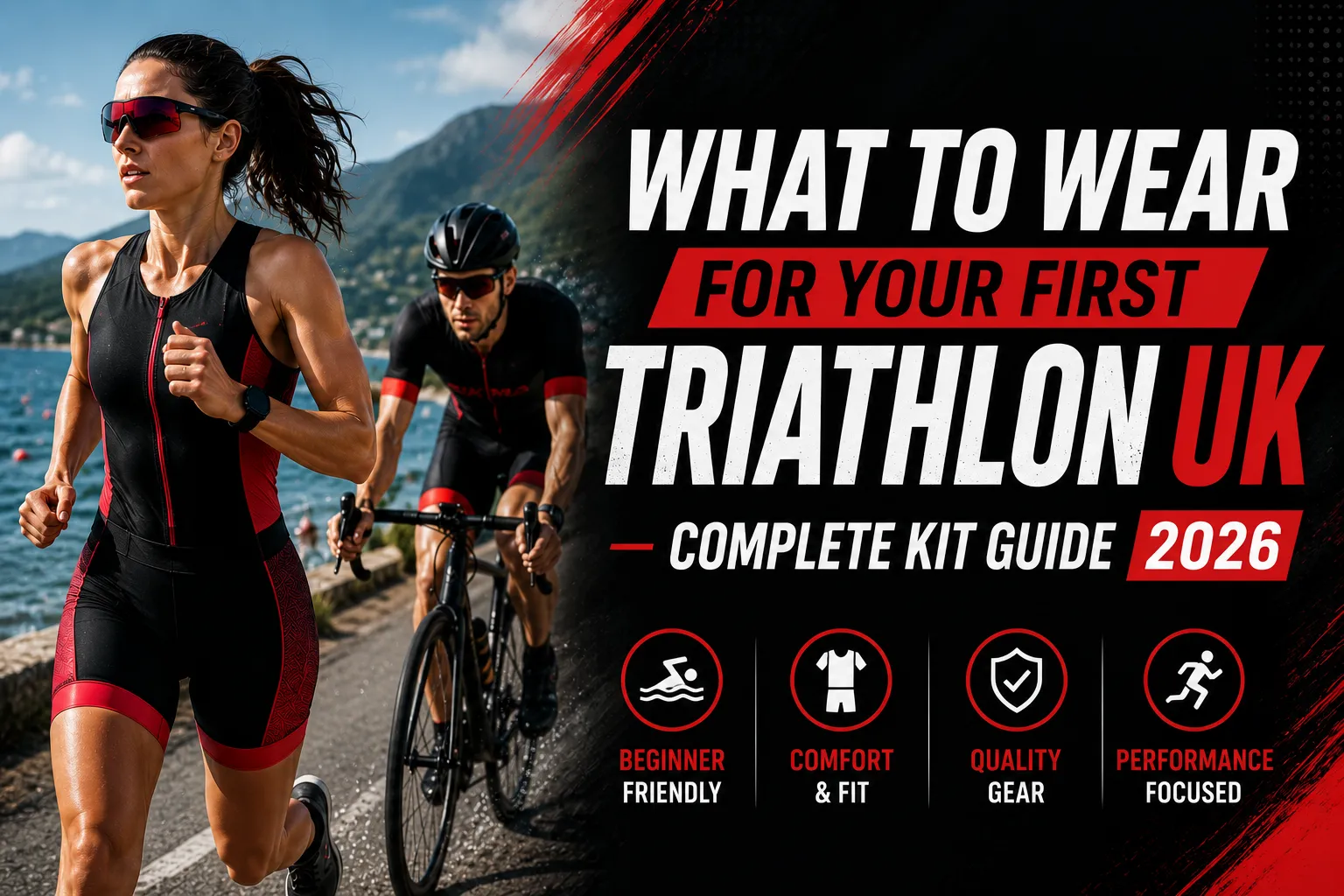
What to Wear for Your First Triathlon UK – Complete Kit Guide 2026
Your first triathlon is coming up and you have one big question nobody warned you about: what on earth do you actually wear? Do you change between disciplines, or do you keep the same kit on the whole time? And what exactly is a trisuit anyway?
If you have been searching “what to wear triathlon” at midnight the week before your race, you are definitely not alone. In fact, getting your triathlon clothing UK sorted is one of the most confusing parts of the whole experience for first-timers. Fortunately, this guide is going to walk you through every single piece of kit you need, what is essential, what is optional, and how to make smart choices that will not leave you uncomfortable on race day.
Do You Change Between Disciplines?
This is the first question every beginner asks, and the answer is: most people do not change at all. Swapping clothes between the swim, bike, and run costs you valuable time in transition. In fact, in a competitive sprint triathlon, even a 2-minute change can drop you several places in the results.
The whole point of proper triathlon clothing UK is that it works seamlessly across all three disciplines. Before the swim, you put it on and that is it for the entire race. Through T1 onto the bike and again through T2 onto the run, the same kit carries you all the way to the finish line. Simple, fast, and completely stress-free.
The Trisuit – The Most Important Piece of Kit
If there is one piece of triathlon clothing UK you invest in before race day, make it a trisuit. Also known as a triathlon skin suit, a trisuit is a one-piece or two-piece outfit specifically designed to be worn for the entire race without changing.
A good trisuit for beginners does several things at once. First, it is made from fast-drying fabric that drains quickly after the swim so you are not cycling in a soggy outfit. Additionally, it has a thin chamois pad that cushions you on the bike without absorbing water or feeling bulky on the run. As a result, it fits close to the body to reduce drag and keep everything in place across all three disciplines.
“I did my first triathlon in regular cycling shorts and a swim top. By kilometre 3 of the run I was chafing, soaking, and deeply regretting every decision. The second race I wore a proper trisuit and it felt like a completely different sport.”
– Customer review, Sikma SportsAt Sikma Sports, the trisuits category covers both men and women with options ranging from sleeveless sprint race designs to short sleeve suits for longer events. For most beginners doing their first UK triathlon, a sleeveless trisuit is the most popular starting point. It is fast in the water, comfortable on the bike, and light enough that the run feels completely natural.
Shop Trisuits for Men and Women
Fast-drying fabric · Thin chamois pad · Compression fit for all three disciplines
What to Wear for the Swim Leg
Your trisuit goes on underneath everything else. On top of that, depending on the water temperature and race rules, you may also need a wetsuit.
🏊 Swim Leg Kit Checklist
- Trisuit – wear it under your wetsuit if using one, or on its own for pool-based triathlons
- Wetsuit – required or permitted in most UK open water triathlons when water temperature is below 22 degrees. Always check your race rules
- Goggles – non-negotiable. Bring a spare pair in your transition bag
- Swim cap – usually provided by the race organiser in a specific colour for your wave. Do not forget to wear it
- Earplugs – optional but very useful for open water swimming in cold UK conditions
For pool-based triathlons, which are very common for beginners across the UK, you will not need a wetsuit at all. In that case, your trisuit alone is perfectly fine. However, for open water events, a triathlon-specific wetsuit is well worth getting if you plan to race regularly. Not only does it add buoyancy and warmth, it also gives you a real confidence boost in cold British waters.
What to Wear for the Bike Leg
Coming out of the water and heading into T1, your trisuit is already doing the work. Beyond that, here is what else you need for the bike leg to stay safe, comfortable, and fast.
🚴 Bike Leg Kit Checklist
- Trisuit – already on you. No changes needed
- Helmet – mandatory in every triathlon in the UK. You cannot leave T1 without it on
- Cycling shoes – clip-in shoes speed up your ride but are not essential for a first race. Running shoes clipped into cages work fine
- Sunglasses – protect your eyes from road debris and UV. A good pair also helps with focus on fast descents
- Arm warmers – optional but very useful for early morning UK races when the temperature drops sharply after the swim
- Race number belt – some events require your number on the bike leg. A belt means you can rotate it to the back for cycling and front for running
| Item | Essential | Notes |
|---|---|---|
| Trisuit | Essential | Worn through entire race |
| Helmet | Mandatory | Race rules require it before leaving T1 |
| Cycling shoes | Optional | Running shoes in cages work for beginners |
| Sunglasses | Recommended | Eye protection and aerodynamics |
| Arm warmers | Optional | Useful for cold UK morning races |
| Race number belt | Recommended | Saves time over pinning a number |
What to Wear for the Run Leg
By the time you are heading out of T2 onto the run, you have already done the hard part. At this stage, the run kit is the simplest of the three disciplines. Your trisuit is still on, your legs are moving, and all you need to do is keep going.
🏃 Run Leg Kit Checklist
- Trisuit – still on, still working. The thin chamois pad in a quality trisuit is designed to be comfortable on the run without adding bulk
- Running shoes – proper running shoes with the laces already loosened or elastic laces fitted. Elastic laces save 30 to 60 seconds in T2
- Race number – rotate your number belt to the front for the run so your number is visible to marshals and photographers
- Cap or visor – optional but helpful in sunny UK summer race conditions
Complete Triathlon Kit List UK 2026
Below is your full triathlon kit list UK summary with everything in one place. Use it to check off your bag the night before race day so you arrive at transition knowing you have not forgotten a thing.
Swim
Trisuit, wetsuit (open water), goggles, swim cap, earplugs (optional)
Bike
Helmet, cycling shoes or trainers, sunglasses, arm warmers (optional), race number belt
Run
Running shoes with elastic laces, cap or visor (optional), race number to front
Transition Bag
Spare goggles, chamois cream, energy gels, water bottle, small towel for T1
| Kit Item | Swim | Bike | Run |
|---|---|---|---|
| Trisuit | Yes | Yes | Yes |
| Wetsuit | Open water | Remove in T1 | No |
| Helmet | No | Mandatory | No |
| Goggles | Yes | Remove in T1 | No |
| Running shoes | No | Optional | Yes |
| Race number | No | Some races | Yes (front) |
What NOT to Wear on Race Day
Just as important as knowing what to wear is knowing what to leave at home. In fact, these are the most common triathlon clothing UK mistakes that first-timers make, and avoiding them can save you a lot of discomfort on race day.
- 1Cotton anything. Cotton holds water and stays wet for hours. Wearing a cotton t-shirt on a triathlon is a recipe for chafing, heaviness, and a miserable run. Every piece of kit you wear should be synthetic and moisture-wicking.
- 2Underwear under your trisuit. Just like padded cycling shorts, a trisuit is designed to sit directly against your skin. Wearing underwear underneath adds friction, bunching, and discomfort. Do not do it.
- 3Brand new kit on race day. Never wear something for the first time on race day. A new trisuit, new shoes, or new goggles that have not been tested in training can cause blisters, rubbing, or failed equipment at exactly the wrong moment.
- 4Regular cycling bib shorts. Standard bib shorts have a thick chamois that absorbs water and becomes heavy and uncomfortable for the run. A trisuit chamois is specifically designed to be thin enough to run in comfortably.
- 5Too many layers. It is tempting to overdress for cold UK mornings but you will warm up fast on the bike. Stick to arm warmers that can be removed, not full jackets you have nowhere to put mid-race.
Complete Your Triathlon Kit with These Accessories
The right accessories finish off your kit and make transitions significantly smoother. As a result, here is what experienced UK triathletes always pack in their transition bag alongside the essentials.
Arm Warmers
Roll them on in T1 for cold bike legs and stuff them in your pocket when you warm up.
Shop Arm WarmersCycling Gloves
Padded palms reduce fatigue on longer bike legs and improve grip in wet UK conditions.
Shop GlovesLeg Warmers
For cold early morning races. Easy to remove and pocket if the sun comes out mid-ride.
Shop Leg WarmersFinal Thoughts
Your first triathlon is going to be one of the most rewarding things you have ever done. Moreover, sorting out your triathlon clothing UK does not have to be complicated or expensive once you know what you actually need.
Start with a quality trisuit that works across all three disciplines, then get your safety kit sorted (helmet, goggles, swim cap), and keep everything else simple. The race itself will throw enough at you, so there is no need for kit problems to add to the stress.
At Sikma Sports, we have everything a first-time triathlete in the UK needs. Browse the full trisuits range to find your race day kit, and do not hesitate to reach out if you need help choosing the right one for your event.
So stop worrying about what to wear and start looking forward to crossing that finish line.
Ready to Gear Up for Your First Triathlon?
Browse the full range of trisuits and triathlon clothing at Sikma Sports – built for UK athletes at every level.

